 blog
blog
B-Stock vs Other Liquidation Marketplaces for Bulk Inventory
Table of Contents
- How B-Stock Compares to Other Liquidation Marketplaces for Bulk Inventory
- What Sets B-Stock Apart in the Liquidation Marketplace Landscape
- B-Stock vs Other Liquidation Marketplaces: Side-by-Side Comparison
- Best Liquidation Websites for Resellers: Matching Marketplaces to Buyer Profiles
- How to Buy Liquidation Pallets: Auction Bidding, Buy Now, and Bulk Lots
- Liquidation Pallet Costs and Fees: What Buyers Actually Pay
- Pallet Flipping Profitability: Margins, Condition Risk, and Resale Value
- Shipping, Freight, and Operational Constraints in Bulk Liquidation
- Conclusion: Choosing the Right Liquidation Marketplace for Bulk Inventory
- Frequently Asked Questions
Last Updated: October 14, 2026
How B-Stock Compares to Other Liquidation Marketplaces for Bulk Inventory
Choosing where to source b-stock liquidation inventory is a high-stakes decision. That difference shapes fees, lot transparency, and how much control you have over what you receive.
Quicklotz has spent over 15 years in reverse logistics. B-Stock is not a single store but a network of marketplaces, each run by a major retailer, so your experience changes depending on which storefront you bid in.
Below, we break down fees, buyer profiles, lot risk, and shipping so you can decide which model fits your operation.
What Sets B-Stock Apart in the Liquidation Marketplace Landscape
B-Stock operates as a B2B marketplace rather than a liquidator. Retailers and brands list excess inventory, customer returns, and damaged goods on branded storefronts, and buyers bid against each other.
That structure has advantages: brand-name goods straight from the source, and some storefronts run frequent, high-volume auctions. If you know a retailer's return patterns, you can specialize.
It also creates friction. Every storefront sets its own rules on buyer eligibility, account approval, minimum purchase, and returns.
B-Stock vs Other Liquidation Marketplaces: Side-by-Side Comparison
The core difference is who owns the inventory. On marketplace platforms, you buy from the retailer through a technology layer; with full-service liquidators, you buy from a company that has already taken possession, sorted, and graded the goods.
| Factor | Marketplace Model (e.g. B-Stock) | Full-Service Liquidator |
|---|---|---|
| Who owns goods | Retailer lists directly | Liquidator buys and holds stock |
| Pricing format | Auction with buyer premium | Daily auctions, buy now, fixed lots |
| Lot transparency | Varies by storefront | Consistent grading and manifests |
| Shipping | Set per retailer | Coordinated freight and delivery |
| Buyer support | Per-storefront | Single point of contact |
| Cost visibility | Hammer price + premium + freight quoted separately | Merchandise cost bundled with freight and handling |
| Lot consistency | Varies by retailer and auction | Standardized condition grades and manifests |
| Minimum purchase | Set per storefront | Often lower entry thresholds on smaller lots |
Neither model is universally better. The marketplace route rewards buyers who can absorb variability; the liquidator route rewards buyers who want predictable manifests and one relationship.
A Landed-Cost Framework You Can Apply to Any Marketplace
The number that determines whether you make money is landed cost per sellable unit, calculated the same way whether you buy through b-stock liquidation, a full-service liquidator, or a regional auction house.
Use this formula before you bid:
- Hammer price or lot price, the winning bid or fixed price.
- Buyer premium, a percentage added on top of the hammer price; marketplace platforms typically charge it, while full-service liquidators often fold it into the lot price.
- Freight and delivery, quoted by weight, distance, and whether the seller coordinates pickup or delivery. Most buyers underestimate this.
- Handling and storage, applies if you delay collection or need the seller to hold the lot.
- Refurbishment, testing, and write-offs, the cost to sort, test, repair, and scrap unsellable units.
- Payment and account fees, card processing, wire fees, or platform account charges.
Divide the total by the units you realistically expect to sell, not the manifest count. A low advertised per-unit price can land above market rate once premium, freight, and write-offs are included.
Where the Two Models Diverge on Cost
Marketplace purchases tend to have lower visible lot prices but more variable total cost, since premium, freight, and condition risk are set per storefront.
The takeaway: if you have the time and systems to calculate landed cost accurately, marketplace platforms can offer better unit economics. If you would rather trade upside for predictability, a full-service liquidator reduces the variables you manage.
Best Liquidation Websites for Resellers: Matching Marketplaces to Buyer Profiles
There is no single best liquidation website, only the best fit for your buyer profile. Here is a decision framework built around four variables that change which marketplace you should use: capital per order, storage capacity, processing labor, and category focus.
A Buyer-Fit Decision Framework
Answer these four questions before you choose a marketplace:
- How much capital can you tie up in a single lot? If your maximum order is a few hundred dollars, prioritize low minimum purchase thresholds and smaller lots. If you can commit several thousand per order, truckload and bulk-lot auctions become viable and usually lower your cost per unit.
- How much storage do you have? A garage limits you to single pallets; a warehouse with racking opens up multi-pallet and truckload purchases, where per-unit costs drop.
- How much processing labor can you sustain per week? Every lot requires receiving, sorting, testing, listing, and shipping. A one-person operation will be buried by high-volume truckloads; a small team makes volume an advantage.
- Do you have a category specialty? Buyers who know a category, consumer electronics, home goods, apparel, tools, can absorb more condition risk because they can test, repair, and price accurately. Generalists should prioritize manifest accuracy over headline price.
Matching Profiles to Marketplace Models
- Part-time eBay resellers: Start with smaller lots and mystery boxes. Low minimum purchase thresholds matter more than rock-bottom unit costs; marketplace platforms with frequent small auctions fit, and full-service liquidators with bundled freight work if lot size matches your storage.
- Amazon and eBay power sellers: Prioritize manifest accuracy and consistent categories over the lowest headline price. A slightly higher lot price with a reliable manifest usually beats a cheap lot with a padded count.
- Discount and bin store owners: You need high volume and repeatable weekly sourcing, so auction frequency beats one-off bargains. Look for daily or weekly auctions in your categories.
- Auction house operators: Look for bulk lots and truckloads you can break into individual lot sales. Freight coordination and delivery timelines matter as much as price.
A Quick Self-Assessment
Before opening an account anywhere, score yourself on these five statements from 1 (not true) to 5 (very true):
- I can calculate landed cost per sellable unit before bidding.
- I have storage for at least one pallet at a time.
- I can process incoming inventory within one week of delivery.
- I know my write-off rate by category.
- I have a category I can price accurately without outside help.
Below 15 suggests starting with smaller lots and a full-service liquidator with consistent grading. Above 20 suggests you can handle marketplace auction variability and may benefit from lower visible prices.
eBay's reseller and seller guidance is a useful starting point for understanding what resale platforms expect from condition disclosures, which in turn tells you how carefully you need to grade incoming stock.
How to Buy Liquidation Pallets: Auction Bidding, Buy Now, and Bulk Lots
Buying liquidation pallets starts with choosing a purchasing method that matches your storage and cash flow. Most marketplaces offer three routes.
- Auction bidding: You compete on price. Best for buyers with time to monitor listings and a clear maximum bid.
- Buy now: Fixed price, immediate purchase. Best when you need a specific category fast.
- Bulk lots and truckloads: High volume, lower cost per unit. Best for established buyers with warehouse space.
For newcomers, auctions teach real market pricing fastest. Watch ten lots close before bidding on one to learn what buyers actually pay, not what the listing suggests.
Liquidation Pallet Costs and Fees: What Buyers Actually Pay
Liquidation pallet costs depend on category, condition grade, lot size, and fee structure. There is no universal price, and any guide quoting a flat figure is guessing.
What you can control is how you evaluate a lot: compare retail value and resale value against your all-in cost, then subtract the portion you expect to write off.
Fees to expect across most models:
- Buyer premium added to the winning bid
- Freight shipping, which scales with weight and distance
- Marketplace or account fees where applicable
- Handling and storage if you delay collection
Quicklotz runs daily online auctions starting at $5, with merchandise generally available at 60-90% off retail, and we coordinate worldwide shipping so freight is quoted as part of the purchase rather than as a surprise.
Pallet Flipping Profitability: Margins, Condition Risk, and Resale Value
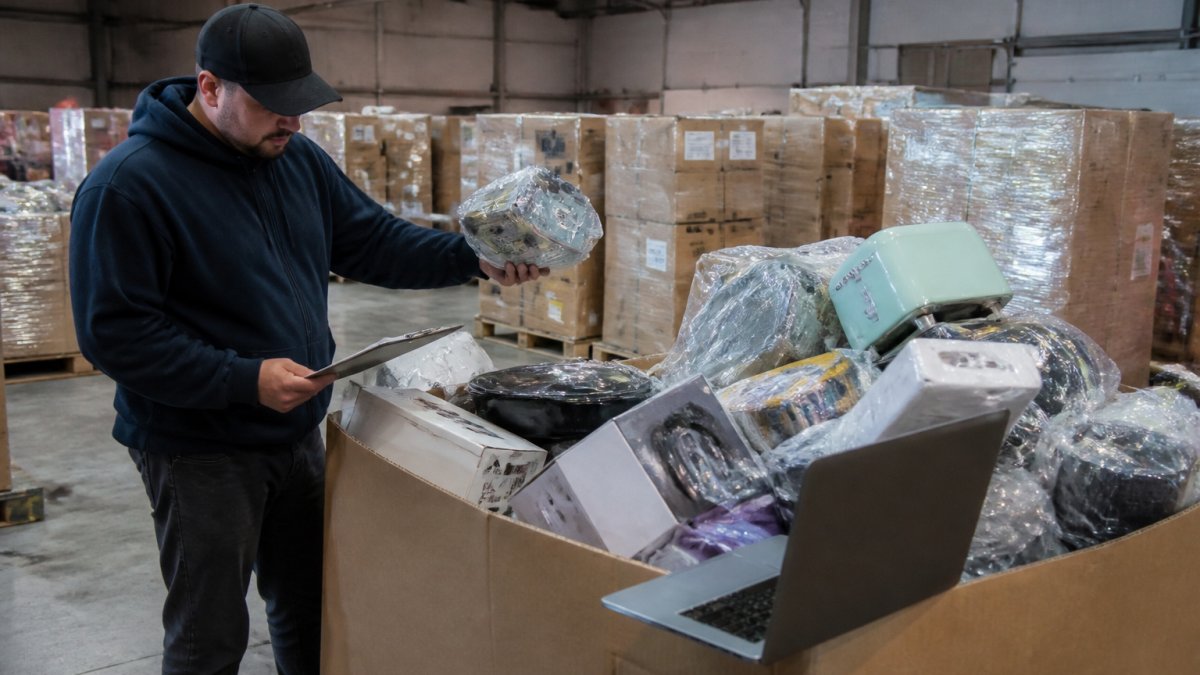
Pallet flipping profitability is driven less by purchase price than by condition risk.
The profitability method that works:
- Calculate cost per sellable unit, not cost per unit
- Grade incoming stock into resell-as-new, refurbish, and scrap
- Track sell-through rate by category for 90 days
- Drop categories where your write-off rate stays high
Condition grade and manifest detail are your only real protection. When a manifest lists item counts and categories, you can forecast. When it does not, you are buying a lottery ticket.
Shipping, Freight, and Operational Constraints in Bulk Liquidation
Freight shipping quietly kills margins on bulk inventory. A great lot price means nothing if delivery costs more than the goods are worth.
Operational factors to weigh before you commit:
- Distance from the warehouse to your location
- Whether the seller coordinates freight or leaves it to you
- Minimum purchase thresholds that force larger orders
- Storage capacity and how fast you can process incoming stock
- Return policy and dispute process if a lot arrives misrepresented
U.S. Small Business Administration guidance on shipping and logistics costs notes that freight and fulfillment expenses are among the most commonly underestimated line items for small product businesses, which matches what we see from buyers moving from single pallets to truckloads.
Buyers near a strategically located warehouse have a structural advantage. If you are not local, ask how delivery is handled before you bid.
Conclusion: Choosing the Right Liquidation Marketplace for Bulk Inventory
B-Stock and similar marketplace platforms suit buyers who want direct retailer access and can manage variability, while full-service liquidators suit buyers who want consistent grading, coordinated freight, and one relationship.
If your priority is reliable supply volume, transparent lot details, and shipping handled for you, Quicklotz is built for exactly that.
Get started with Quicklotz and build a sourcing pipeline you can actually plan around.
Frequently Asked Questions
How profitable is pallet flipping?
Profitability depends on the lot source, condition grade, and your resale channel. Buyer premiums, freight shipping, and unsellable items cut into margins. Resellers who inspect manifests carefully and avoid lots with high damage rates tend to see better returns than those buying blind.
What is the difference between B-Stock and other liquidation marketplaces?
B-Stock operates as a B2B marketplace platform hosting retailer-specific auction storefronts, meaning inventory comes directly from major retailers rather than a single centralized warehouse. Other liquidation marketplaces often aggregate inventory from multiple sources and sell fixed-price or auction lots. The key differences are buyer eligibility requirements, whether you bid against other resellers or buy at a set price, and how much lot-level condition detail is disclosed before purchase.
What costs should I consider when buying liquidation pallets?
Beyond the winning bid, factor in buyer premiums (often 10-15% on auction platforms), freight shipping or local pickup costs, marketplace fees, and the cost of unsellable or damaged items. A pallet that looks cheap per unit can become expensive once you add $200-$500 in freight and discover 20% of items are unsellable. Always calculate total landed cost per sellable unit before bidding.
How do I evaluate a bulk liquidation lot before bidding?
Review the manifest for item count, product categories, and condition grade. Check whether the lot is retailer-supplied returns, overstock, or damaged goods. Look for lot details like retail value estimates and whether the marketplace offers a return policy or money-back guarantee. If possible, start with smaller bulk lots to test a marketplace's accuracy before committing to truckloads. Consistent manifest accuracy matters more than the lowest price per unit.