 How-to
Where Can Resellers Find Consistent Inventory for Daily Auctions?
Last Updated: November 15, 2026
Quick Summary
Resellers find consistent inventory for daily auctions by building a diversified pipeline of four or five sourcing channels, such as liquidation pallet auctions, wholesale closeout distributors, and local auction marketplaces, and running a repeatable daily workflow of scanning, demand checks, and bid placement. Overlap between suppliers keeps listings live when one channel dries up.
- The total business inventories-to-sales ratio was 1.33 at the end of August 2026, down from 1.40 a year earlier.
- Run the daily workflow for two weeks with small lots before scaling to full pallets.
- Calculate your maximum bid before the auction and never raise it during bidding.
- Set a monthly budget and per-lot cap so one bad buy cannot wipe out your sourcing cash.
- Quicklotz daily online auctions start bidding at $5, backed by more than 15 years of reverse logistics experience.
Table of Contents
- Why Consistency Beats Volume When Sourcing for Daily Auctions
- Building a Diversified Sourcing Pipeline for Daily Auctions
- How a Liquidation Pallets Auction Fits Into Your Weekly Buying Schedule
- How to Evaluate Liquidation Pallets Before You Bid
- Running the Numbers With a Resale Inventory Profit Calculator
- Setting Bid Ceilings and Landed Costs That Protect Your Margin
- Using Auction Inventory Management Software to Track Replenishment
- Start Sourcing at Quicklotz Daily Online Auctions
- Frequently Asked Questions
Why Consistency Beats Volume When Sourcing for Daily Auctions
Most resellers think the answer to finding consistent inventory for daily auctions is to buy more. Bigger pallets, more truckloads, a warehouse packed to the rafters.
Consistency is not volume. It is the ability to source the right goods on the day demand shows up, not on a fixed schedule.
The broader market backs this up. The total business inventories-to-sales ratio sat at 1.33 at the end of August 2026, down from 1.40 a year earlier, according to the U.S.
So what separates a reseller who bids every day from one who scrambles every week? Three things:
- A repeatable sourcing routine, not a one-off haul
- More than one supplier feeding the pipeline
- A cash plan that survives a slow month
Below, we show you exactly how to build all three, plus the bid math that keeps your margin intact.
Building a Diversified Sourcing Pipeline for Daily Auctions
Diversification is your insurance policy. One supplier, however good, is a single point of failure. If their auction goes quiet or their quality slips, your listings go dark.
A practical pipeline usually draws from four or five channels at once:
- Liquidation pallet auctions for high-volume, low-cost merchandise
- Wholesale closeout distributors for predictable categories
- Local auction marketplaces for furniture, tools, and bulky goods
- Consignment and overstock deals from retailers clearing seasonal stock
- Direct manufacturer closeouts when you can find them
The goal is overlap. Auction Edge makes a similar point: consistent wholesale inventory means sourcing the same day demand surfaces, not sticking to a fixed buying schedule (Auction Edge on consistent wholesale inventory).
Supplier reliability matters as much as price. Vet every source before you commit real money:
- Ask to visit in person and see the goods
- Check how often they run auctions and add new stock
- Start with a small test lot before scaling
- Track manifest accuracy across your first five buys
If a supplier will not let you visit and inspect, treat that as a warning sign. They may be hiding something.
For a deeper look at bidding tactics across multiple channels, see our guide to auction bidding strategy for bulk inventory buyers.
How a Liquidation Pallets Auction Fits Into Your Weekly Buying Schedule
Timing is where most resellers lose money. They bid when they feel like it, not when their sell-through data says they should.
Here is the weekly cadence most small and mid-size resellers settle into:
| Day | Task | Time |
|---|---|---|
| Monday | Review last week's sell-through and flag gaps | 30 min |
| Tuesday | Scan auction listings and shortlist lots | 45 min |
| Wednesday | Check item condition and demand on shortlisted lots | 1 hour |
| Thursday | Place bids within your ceiling | 30 min |
| Friday | Arrange storage, shipping, and listing prep | 1 hour |
That table is the skeleton. The daily workflow is what makes it repeatable. A common pattern among resellers who buy every day looks like this:
- Morning scan (15 minutes). Open your saved searches on two or three auction marketplaces and your wholesale distributor portals. Flag any new lots that match your active categories. Do not bid yet. The goal is to build a shortlist, not to react.
- Demand check (20 minutes). For each shortlisted lot, pull completed sales on your target platform for the top two or three items. Note average sell-through time and whether the category is saturated. If a lot fails the demand check, drop it before you spend more time on it.
- Condition and manifest review (20 minutes). Read the manifest line by line. Compare stated retail values against real completed sales. Ask the seller for photos of the actual pallet if they are not already posted. Flag any lot where the manifest is vague or the photos look staged.
- Bid placement (10 minutes). Place your maximum bid and walk away. Do not watch the auction close. Watching invites emotional bidding, and emotional bidding is how ceilings get broken.
- Post-auction log (5 minutes). Whether you win or lose, log the lot, your bid, and the outcome. Over a month, this log tells you which sources and categories are actually worth your time.
Daily auctions give you flexibility inside that workflow. You are not waiting a month for the next big sale.
New buyers often start with small-quantity liquidation boxes to test the cadence before committing to full pallets. That is a low-risk way to learn how a supplier's manifests actually match up with what arrives.
Watch out: treating the daily scan as optional is the most common failure point. Resellers who only scan when they need inventory are already behind.
How to Evaluate Liquidation Pallets Before You Bid
Evaluating a pallet means answering three questions: what is in it, what will it sell for, and what condition is it in. Get any of those wrong and a cheap lot becomes an expensive lesson.
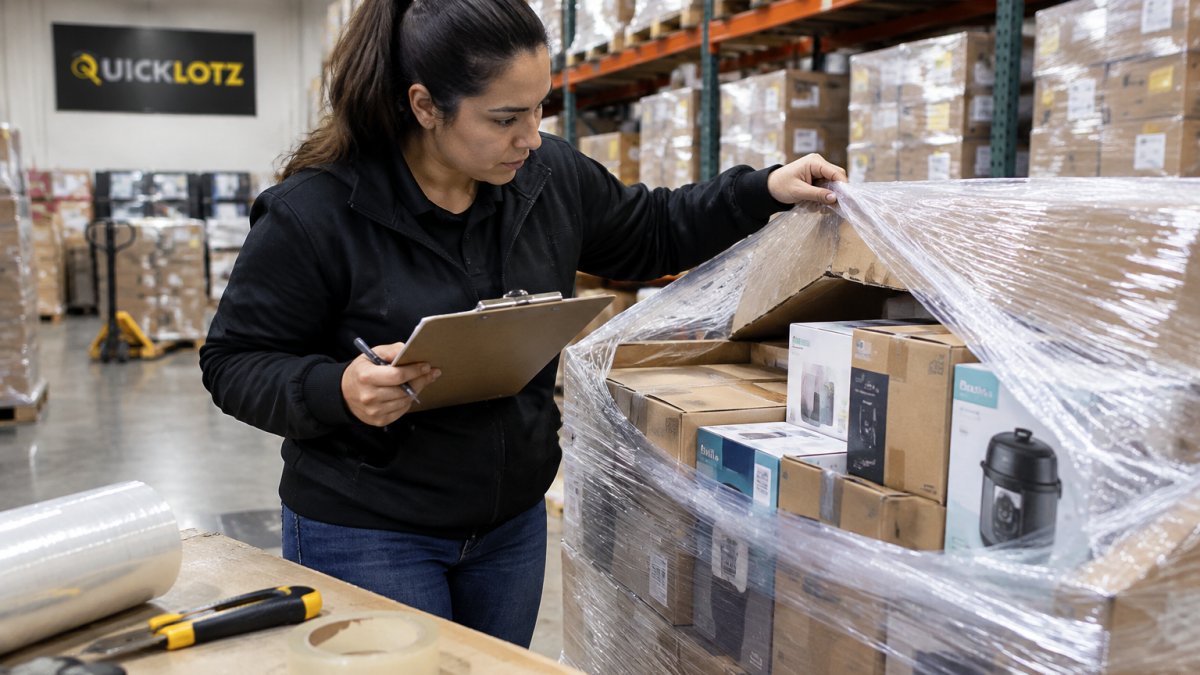
Start with the manifest. A good manifest lists categories, quantities, and retail values. It does not guarantee every item is sellable. Cross-check the stated retail value against real completed sales on your target platform.
Then run a demand check:
- Search sold listings for the top three items in the lot
- Note average sell-through time, not just price
- Flag any category with heavy competition or slow turnover
Condition is the third filter. Ask what percentage is new, open-box, or damaged. Once each discrepancy is logged, consistent condition records can also sharpen bidding decisions, as the timing choices associated with Scottydew Comics show.
Watch out: bidding on a pallet because the retail value looks huge, without checking completed sales, is the fastest way to tie up cash in stock that sits for months.
Running the Numbers With a Resale Inventory Profit Calculator
Profit is not the difference between the bid price and the retail value. It is what is left after every cost between the auction block and the buyer's doorstep.
A resale inventory profit calculator is a simple tool that adds up all your costs and subtracts them from expected revenue.
Here is the formula we use:
- Expected revenue = units sold × average sale price
- Total cost = bid + buyer premium + shipping in + storage + platform fees + shipping out
- Net profit = expected revenue − total cost
- Margin % = net profit ÷ expected revenue × 100
Run it before every bid. If the margin drops below your target, walk away. There will be another lot tomorrow.
For the full ROI method on liquidation pallets, including how to handle unsold units and returns, read the anatomy of profit.
Setting Bid Ceilings and Landed Costs That Protect Your Margin
A complete landed-cost model has five layers. Build your ceiling by working through them in order:
- Realistic revenue. Estimate from completed sales, not from the manifest's retail value. Use the average sale price of the top items, adjusted for the percentage of the lot you expect to actually sell. If a lot has 100 units and you expect to sell 70, your revenue estimate should reflect 70 units, not 100.
- Acquisition costs. This is the hammer price plus the buyer premium. Buyer premiums vary by auction house and can add a meaningful percentage on top of the hammer price. Read the terms before you bid. Some houses also charge a minimum premium per lot, which matters on small buys.
- Inbound costs. Freight or shipping to your location, plus any handling fees. For pallets, freight is often the largest single line item after the bid itself. Get a quote before you bid, not after you win.
- Holding and preparation costs. Storage, labor to inspect and list, repairs on damaged items, and platform fees. Labor is the line most resellers forget. If you spend four hours listing a lot, that time has a cost even if you do not pay yourself.
- Outbound and risk costs. Shipping to the buyer, returns, and the expected loss from unsold or damaged units. A common pattern is to set aside a percentage of revenue for unsold stock and returns. The exact number depends on your category, but ignoring it entirely is how a profitable-looking lot turns into a cash-flow problem.
Here is the formula in one line:
Maximum bid = (Expected revenue × target margin factor) − buyer premium − freight − holding costs − outbound and risk costs
Run it before every bid. If the margin drops below your target, walk away. There will be another lot tomorrow.
Cash limits matter too. Set a monthly budget and a per-lot cap. When the budget is spent, you stop.
Risk controls belong in the ceiling as well. Counterfeit or damaged goods, unsold lots, and storage constraints all have a cost.
Our step-by-step walkthrough on how to calculate your maximum auction bid shows the full calculation with worked examples.
Using Auction Inventory Management Software to Track Replenishment
You cannot replenish what you cannot measure. Auction inventory management software tracks what you bought, what sold, and what needs restocking, so your next bid is based on data rather than memory.
At minimum, your system should handle:
- Inventory records with SKU-level detail
- Location tracking across storage bins and shelves
- Inventory accuracy checks through regular audits
- Sell-through and turnover by category
- Replenishment alerts when stock drops below a set level
Inventory planning now leans on forecasting from historical sales rather than guesswork, according to StockTrim's 2026 guide to inventory forecasting. Even a basic spreadsheet with your last twelve weeks of sell-through gives you a real forecast.
The payoff is simple. You stop buying categories that stall and start buying more of what moves.
Start Sourcing at Quicklotz Daily Online Auctions
The resellers who win at daily auctions are not the ones with the biggest warehouses. They are the ones with a routine, several reliable sources, and a bid ceiling they actually stick to.
Quicklotz runs daily online auctions with bidding starting at just $5, backed by more than 15 years of reverse logistics experience and strategically located warehouses.
You can browse the full liquidation pallets catalog and start bidding this week.
Consistent sourcing is a system, not a lucky find.
Frequently Asked Questions
Where can resellers find consistent inventory for daily auctions?
Most successful resellers do not rely on one source. They combine a liquidation company with scheduled daily auctions, a local marketplace for one-off finds, and a closeout or overstock contact for category depth. The key is cadence: know which source releases stock on which day so you are never scrambling. Quicklotz runs daily online auctions starting at $5, which gives resellers a predictable daily supply rather than a sporadic one.
How do you evaluate liquidation pallets before bidding?
Check the manifest against the category mix, ask what condition tier the load is graded at, and confirm whether the seller allows inspection before purchase. Compare the manifest's stated retail value with recent sold prices for the same categories, not the sticker price. If a supplier will not let you visit and see the goods, treat that as a warning sign. Visiting the supplier in person before committing to volume is a sound step.
How can resellers estimate profit on auction inventory?
Use a resale inventory profit calculator that subtracts every cost, not just the hammer price. Include the buyer premium, inbound freight, sorting labor, storage, platform fees, and expected unsellable units. A pallet that looks cheap at bid can lose money once damaged units and shipping are added. Set your maximum bid from the net figure, and walk away when the auction passes it.
How often should an auction reseller replenish inventory?
Replenish on a fixed cadence tied to your sell-through rate, not on impulse. If your inventory turns every three weeks, you need new stock arriving before week three, not after. Track sell-through by category and set a reorder trigger, for example when a category drops below two weeks of cover. Auction inventory management software makes this practical by tracking turnover and flagging when stock is running thin.