 how-to
7 Steps to Calculate Your Maximum Auction Bid
Last Updated: October 30, 2026
Quick Summary
To calculate your maximum auction bid, start with the estimated resale value, subtract your target profit and post-auction costs, then divide by one plus the buyer's premium rate. This gives the highest amount you can pay, fees included, while still hitting your profit target.
- A maximum auction bid is your ceiling, not your opening offer.
- Buyer's premiums, processing fees, sales tax and freight all stack on top of the winning bid.
- With a $1,200 resale value, $300 profit target, $150 costs and 15% premium, your maximum bid is about $652.
- Tiered premiums make the calculation nonlinear, so check whether the premium is flat or sliding before dividing.
- Test your ceiling against a 20% lower resale value and higher freight before you commit.
Table of Contents
- What a Maximum Auction Bid Really Means (and Why It Matters)
- The Maximum Bid Formula You Can Reuse
- How to Calculate Buyer's Premium and Other Auction Fees
- A Maximum Bid Example for Liquidation Inventory
- Using an Auction Max Bid Calculator (and When to Build Your Own)
- How Auction Formats and Platform Rules Change Your Ceiling
- Sensitivity Analysis: Stress-Testing Your Bid Before You Commit
- Next Step: Source Inventory with a Bid You Can Defend
- Frequently Asked Questions
What a Maximum Auction Bid Really Means (and Why It Matters)
A maximum auction bid is the highest amount you will pay for a lot, fees included, before you walk away. It is your ceiling, not your opening offer. Bidders who win lots and still lose money often set a ceiling based on the hammer price alone.
Here is the part most guides skip. The number you type into a bidding platform is not the number that leaves your bank account. Buyer's premiums, processing fees, sales tax and freight all stack on top.
That single shift in thinking separates resellers who scale from resellers who quit after three months.
The Maximum Bid Formula You Can Reuse
Start with the resale value, subtract every cost, and work backward. That is the whole idea. Here is the formula we recommend:
Maximum bid = (Estimated resale value − Target profit − Post-auction costs) ÷ (1 + Buyer's premium rate)
Each piece matters:
- Estimated resale value: what the goods will actually sell for, not the manifest's retail claim
- Target profit: the margin you need to make the effort worthwhile
- Post-auction costs: freight, tax, handling, storage
- Buyer's premium rate: the auction house's cut, expressed as a decimal
Worked Example: Flat Buyer's Premium
Suppose a pallet has a realistic resale value of $1,200. You want $300 profit. Freight and tax will depend on your location and carrier. The buyer's premium is a flat 15%.
- Subtract profit and post-auction costs from resale value: $1,200 − $300 − $150 = $750
- Divide by (1 + premium rate): $750 ÷ 1.15 = about $652
Your maximum bid is roughly $652. Bid $700 and your profit target disappears into the premium.
Worked Example: Sliding-Scale Buyer's Premium
Some auction houses use a tiered premium: for example, 20% on the first $500 of the hammer price and 15% on the portion above $500.
Let's solve for the maximum bid when the premium is tiered. You want the total cost (hammer price + premium + post-auction costs) to equal resale value minus target profit.
Let B be the hammer price. The premium is:
- 20% of the first $500 = $100
- 15% of the amount above $500 = 0.15 × (B − $500)
Total premium = $100 + 0.15B − $75 = $25 + 0.15B
Total cost = B + ($25 + 0.15B) + $150 = 1.15B + $175
Set total cost equal to resale value minus target profit: 1.15B + $175 = $1,200 − $300 = $900
Solve: 1.15B = $725 → B = $630.43
Adapting the Formula to Different Auction Types
The formula above assumes a standard English auction with a buyer's premium. For other formats:
- Sealed-bid auction: you submit one number with no chance to adjust. Use the same formula, but add a safety margin to your target profit to account for the lack of information.
- Proxy bidding: the platform bids on your behalf up to your maximum. The formula still works, but remember that your maximum is binding, you cannot lower it after the auction starts.
- Live auction with increments: bid increments can push the final price above your ceiling if you are not careful. Set your maximum before the auction and stick to it; do not let the rhythm of the room override your math.
If the math feels abstract, work through the profit side with a simple spreadsheet before you bid on your first truckload. For the ROI math behind the formula, see The Anatomy of Profit: Calculating ROI on Liquidation Pallets for Maximum Earnings.
How to Calculate Buyer's Premium and Other Auction Fees
Buyer's premium is the fee an auction house adds to your winning bid, and it is usually the biggest hidden cost. A premium quoted as a percentage applies to the hammer price, not to your budget.
Work through the fees in this order:
- Buyer's premium: multiply your winning bid by the premium rate
- Processing or transaction fee: often a flat charge per lot or per invoice
- Sales tax: applied to the taxable total, which may include the premium
- Freight and delivery: quoted separately, and rarely small
Some platforms use a tiered or sliding fee scale, where the premium rate drops as the bid amount rises.
Freight deserves its own line in your budget. Our breakdown of freight and shipping costs for liquidation truckloads covers what first-time buyers should expect to set aside.
A Maximum Bid Example for Liquidation Inventory
Picture a pallet of general merchandise with a verified manifest showing a realistic resale value of $1,200. You want $300 profit. Freight and tax will run about $150. The buyer's premium is 15%.
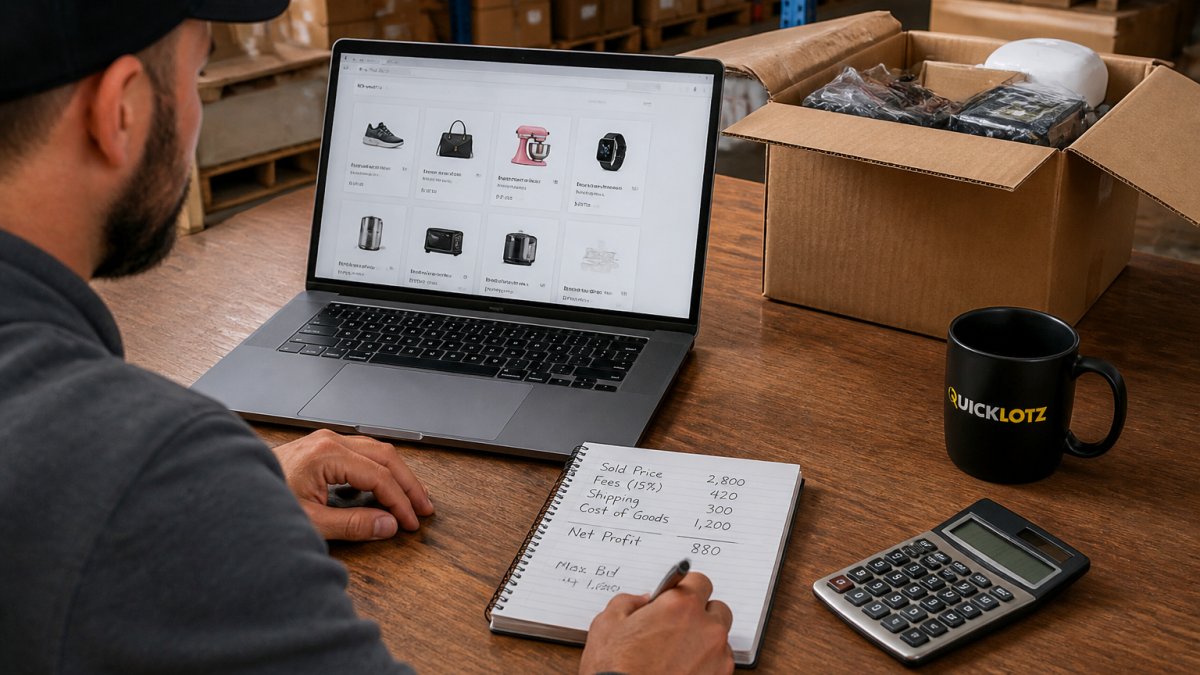
Run the formula:
- $1,200 − $300 − $150 = $750
- $750 ÷ 1.15 = about $652
So your maximum bid is roughly $652. Bid $700 and your profit target disappears into the premium. This is why buyers should verify the manifest before trusting the resale figure.
Using an Auction Max Bid Calculator (and When to Build Your Own)
An auction max bid calculator does the arithmetic for you, but only if you feed it honest inputs. Most online calculators ask for resale value, fees and target profit, then return a ceiling. The output is only as good as the resale estimate you type in. Refining your valuation process becomes even more critical when you purchase authenticated collectibles to ensure your final bid reflects the true market standing of the item.
Build your own spreadsheet when you bid regularly. A simple four-column sheet works:
| Column | What to Enter | Why It Matters |
|---|---|---|
| Estimated resale value | Realistic sold price, not retail | Sets the whole calculation |
| Total fees | Premium, processing, tax | Prevents surprise costs |
| Post-auction costs | Freight, handling, storage | The most-forgotten line |
| Target profit | Your minimum acceptable margin | Keeps you disciplined |
The advantage of your own sheet is that you can save each lot and compare ceilings across auctions. Off-the-shelf calculators rarely store history.
How Auction Formats and Platform Rules Change Your Ceiling
Auction format changes how you should bid, even when the math stays the same. The key differences come down to three questions: Is your maximum binding? How are bids incremented? And what happens in a tie?
Proxy Bidding
In a proxy bid system, you enter your true maximum and the platform bids for you in increments up to that number. Your maximum is binding, you cannot lower it after the auction starts, and the system may use it to outbid others automatically. That is convenient, but it means your ceiling is visible to the system, so set it honestly and never raise it mid-auction out of emotion. If two bidders submit the same maximum, the earlier bid typically wins, so submit your true ceiling early rather than waiting.
Live Incremental Bidding
In a live auction, the auctioneer calls bids in set increments (for example, $10 increments up to $200, then $25 increments above that). You can react to the underbidder, which tempts you to chase. The increment schedule matters: if the next increment would push you past your ceiling, you must stop. Know the increment schedule before the auction begins so you can calculate exactly where your ceiling falls relative to the next bid.
Sealed-Bid and Blind Auctions
In a sealed-bid auction, you submit one number with no visibility into others. Your ceiling must stand alone, there is no chance to adjust. Blind auctions are similar but often have a single round. In both formats, add a safety margin to your target profit because you have less information about competing bids.
Platform Rules That Affect Your True Cost
Beyond the bidding mechanism, platform rules change your effective ceiling:
- Pickup windows: if you cannot pick up within the stated window, you may incur storage fees that eat into profit.
- Sales tax handling: some platforms collect tax on the hammer price plus premium; others collect on the hammer price only. Check which applies.
- Payment deadlines: missing a payment deadline can result in forfeiture or penalties.
- Tie handling: in some formats, ties are broken by bid time; in others, by random draw. Know the rule so you can decide whether to bid early.
Buyers should review the platform's rules before the gavel falls. The platform's Frequently Asked Questions cover ordering, pickup, and sales tax rules that affect your true cost. Always read the platform's bidder agreement before you set your ceiling, the rules can change your true cost by several percentage points.
Sensitivity Analysis: Stress-Testing Your Bid Before You Commit
Sensitivity analysis means testing your ceiling against worse numbers before you bid, and it is the step almost everyone skips. Ask three questions:
- What if resale value comes in 20% lower than I estimated?
- What if freight runs higher than quoted?
- What if the premium pushes my total cost past my target profit?
If your ceiling still leaves a thin but positive margin under those conditions, bid. If it turns negative, lower your ceiling or walk away. A bid that only works under perfect assumptions is not a bid, it is a gamble.
Next Step: Source Inventory with a Bid You Can Defend
The hard part is not the formula. It is having reliable inventory and honest manifests to plug into it. Quicklotz has more than 15 years of experience in reverse logistics, running daily online auctions with worldwide shipping and strategically located warehouses. You get access to desirable categories of goods at 60-90% off.
When you are ready to put your ceiling to work, visit the Quicklotz website for current inventory and a quote.
Frequently Asked Questions
Should shipping and taxes be included in a maximum auction bid?
Yes. Shipping, delivery, and sales tax are part of your total cost and must be subtracted before you set your maximum auction bid. A $500 winning bid can become $650 or more once transport and tax are added. Estimate these costs first, then work backward to the bid amount that still leaves your target profit. If you cannot estimate shipping accurately, use a conservative high figure so your bid ceiling stays safe.
How do buyer's premiums affect your maximum auction bid?
The buyer's premium is a percentage added to the winning bid, and it lowers the hammer price you can afford. If the premium is 15% and your total budget is $1,000, your maximum bid is not $1,000; it is $1,000 divided by 1.15, or about $869. Always calculate the premium before bidding, and check whether the rate changes at higher bid amounts, because a tiered fee scale can shift your ceiling.
What is the difference between a maximum bid and a proxy bid?
A maximum bid is the highest amount you are willing to pay. A proxy bid is the automated system that bids on your behalf up to that maximum, usually in fixed increments. You enter your maximum bid once, and the platform places incremental bids as needed to keep you ahead, without exceeding your limit. Understanding this distinction helps you avoid bidding wars and keeps your price ceiling intact.
How much profit margin should you leave when buying items at auction?
Most resellers aim for a gross margin of at least 30% after all costs, but the right number depends on your platform, sell-through rate, and return rate. For liquidation inventory, factor in unsold or damaged items. A practical approach is to set a target profit percentage, subtract it from your estimated resale value along with fees and transport, and treat the remainder as your maximum bid. Test your margins on small lots before scaling.
Set a ceiling you can defend, and let the auction come to you. Contact Quicklotz for details on upcoming auctions and shipping to your area, and start bidding with numbers that protect your margin instead of eroding it.