 how-to
How to Verify Liquidation Pallet Manifests Before You Bid
Last Updated: October 28, 2026
Quick Summary
To verify liquidation pallet manifests, read each line and validate the SKU or UPC against a lookup tool, flagging any identifier that is missing, mismatched, duplicated, or obsolete. Then score the share of fully specified lines before you bid, since a manifest lists what should be inside a pallet, not proof of what is actually in the boxes.
- Check that the header's total item count matches the sum of the line items.
- A declared retail value that is implausible for the category is a red flag.
- Tally the condition mix by line, not by unit, before looking at the bid price.
- A completeness score below 50% complete is a red flag.
- Photograph the pallet and each box before you break the pallet.
Table of Contents
- Why a Manifest Is Not a Guarantee (and What to Do About It)
- The Line-by-Line Verification Workflow
- How to Improve Liquidation Pallet Manifest Accuracy Before You Buy
- Common Liquidation Pallet Scams and Warning Signs
- Calculating Profit Margins on Liquidation Pallets
- Post-Delivery Verification: Matching the Manifest to the Physical Pallet
- Start Verifying Your Next Pallet with Quicklotz
- Frequently Asked Questions
Why a Manifest Is Not a Guarantee (and What to Do About It)
Liquidation pallet manifests list what should be inside a pallet, not proof of what is actually in the boxes. That gap is where good buys turn into expensive lessons, and it is the most important thing to understand about how to verify liquidation pallet manifests before you bid.
At Quicklotz, we have spent more than 15 years in reverse logistics. The Federal Trade Commission's guidance on deceptive advertising makes clear that sellers cannot misrepresent what a buyer is getting, but a manifest that says "assorted general merchandise" is technically accurate and still useless to you.
So you verify: read the manifest line by line, check the identifiers, question the vague entries, and score your uncertainty before you bid.
The Line-by-Line Verification Workflow
Verification is a repeatable process, not a gut check. Run the same five steps on every lot, ordered from cheapest check to most expensive, so you can abandon a bad manifest early instead of wasting time on a lot you would never bid on.
Step 1: Read the Header and Lot Summary
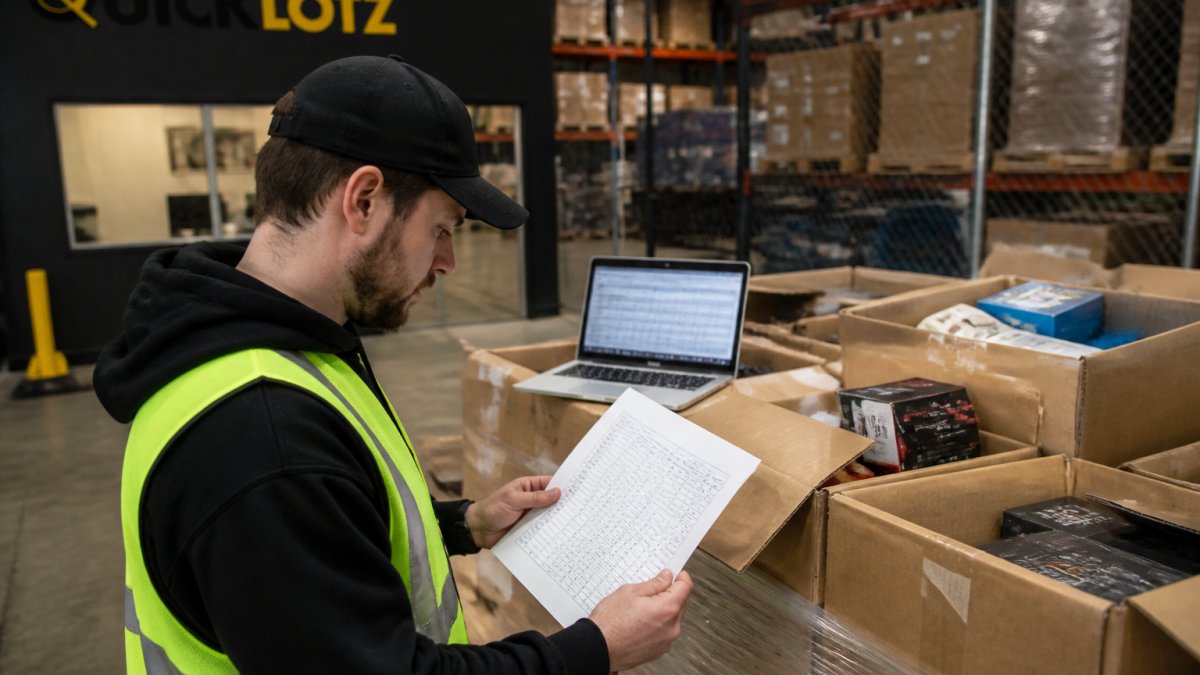
Start at the top. The header gives the lot number, total item count, declared retail value, and category mix. Check that the total count matches the sum of the line items. If the header says 240 units but the lines add up to 198, ask why in writing before the auction closes, a mismatch is not always fraud, but it is always a question worth asking.
Also compare declared retail value to the category mix. A pallet of phone cases with a declared retail value of $8,000 is a red flag.
Step 2: Decode Item Descriptions and Condition Codes
Condition codes are where value lives or dies. Common labels include new, open box, used, customer returns, and salvage. Flag anything vague, such as "misc" or "assorted."
Tally the condition mix by line, not by unit. Write the mix down before you look at the bid price.
Step 3: Validate SKUs, UPCs, and Product Identifiers
A product identifier is your fastest reality check, but only if you validate it correctly. Work through these checks in order:
- Does the identifier resolve at all? Look up the SKU or UPC on a marketplace or public UPC lookup tool. If it returns no product, the identifier may be obsolete, internal-only, or invented. Note it and move on, do not assume the item is fake, but do not pay full value for it either.
- Does it resolve to the right product? A UPC that resolves to a completely different item, a phone case when the manifest says headphones, is a hard red flag. Either the manifest line is wrong or the identifier was reused. Both mean you cannot trust that line's description.
- Is the identifier duplicated across lines? Duplicates usually mean the seller consolidated a multi-pack, the same item appears in two condition grades, or the manifest was assembled from a template. Ask which. Duplicates inflate apparent variety and can hide quantity errors.
- Is the identifier obsolete or discontinued? A valid UPC for a product discontinued years ago tells you the pallet is old inventory. Not automatically bad, but resale demand is thinner and parts availability is worse. Price accordingly.
- Is the identifier missing entirely? Missing identifiers are just as telling as wrong ones. A manifest with no SKUs or UPCs on most lines gives you no way to verify anything, which means your uncertainty discount should be larger.
Step 4: Check Quantities and Flag Missing Items
Add up quantities per line and compare to the stated item count.
Step 5: Score the Manifest Before You Bid
Before you bid, write a one-line verdict using a simple completeness score. Count the lines that have all four of: a resolvable identifier, a clear condition code, an exact quantity, and a specific product description. Divide by total lines.
| Step | What You Check | Red Flag |
|---|---|---|
| Header and lot summary | Item count, declared value | Totals do not add up; retail value implausible for category |
| Descriptions and condition | Condition codes, wording | Vague "misc" entries; salvage-heavy line count |
| SKUs and UPCs | Identifier resolves to the right product | No match, wrong product, duplicates, obsolete codes |
| Quantities | Line totals vs. stated count | "Qty varies" ranges |
| Completeness score | Share of fully specified lines | Below 50% complete |
How to Improve Liquidation Pallet Manifest Accuracy Before You Buy
You can ask questions before the auction closes.
Ask for photos of the actual labels, not just the manifest page. Request the source retailer or category. Confirm whether the count is audited or estimated. Then score what you get:
- Complete: every line has a SKU, condition, and exact quantity
- Partial: most lines are detailed, a few are vague
- Thin: heavy use of "assorted," "misc," or ranges
Before you commit, read the conditions of sale that govern what the manifest actually promises.
Common Liquidation Pallet Scams and Warning Signs
If you want a deeper walkthrough on spotting unprofitable lots, our guide on how to identify profitable liquidation pallets covers the pitfalls in detail.
Calculating Profit Margins on Liquidation Pallets
Profit margin math is where enthusiasm meets reality.
Add the bid, buyer fees, and shipping cost together. Then estimate resale value using real sold listings, not retail value.
Landed cost = bid price + buyer fees + shipping cost
Potential margin = (estimated resale value x sell-through rate) - landed cost
For the full math, see our breakdown of calculating ROI on liquidation pallets.
Post-Delivery Verification: Matching the Manifest to the Physical Pallet
The manifest check does not end at the auction, it ends when you open the boxes, and the way you open them determines whether you have a dispute or just a complaint. Most buyers rush this step, and it decides whether a bad lot becomes a recoverable loss or a total one.
Before You Break the Pallet: Document Everything
Photograph the pallet before you cut the wrap: the wrap, shipping label, lot number sticker, and any condition or handling labels. Then photograph each box or tote as you remove it, in stacking order.
Reconcile Line by Line, Not Box by Box
Do not count boxes and call it done. Reconcile against the manifest line by line, because that is the unit the seller's records are built on. For each line, record four things:
- Units received vs. units declared. Count the actual units, not the boxes. A box that should hold six units but holds four is a quantity discrepancy even though the box count matches.
- Identifier match. Scan or read the UPC or SKU on the physical item and compare it to the manifest line. A physical item whose identifier does not match the manifest line is a mismatch, even if the description sounds right.
- Condition match. Compare the physical condition to the manifest's condition code. "New" that arrives in a crushed retail box is not new for resale purposes, and you should document it as a condition discrepancy.
- Description match. Note any item that is materially different from its line description, wrong model, wrong color, wrong size, or a substitute product.
Score the Discrepancy Before You File
- Material: missing units above roughly 5% of the line, wrong products, or condition downgrades that change resale channel. These are worth pursuing.
- Minor: small count shortfalls, packaging damage that does not affect the product, or description wording that is technically accurate but imprecise. Document them, but do not lead with them.
- Ambiguous: lines that said "qty varies" or "assorted." These are hard to dispute because the manifest did not promise a specific count or item. Note them as a reason to discount that seller next time rather than as a claim.
File the Claim the Way the Seller Expects
If you want a deeper walkthrough on spotting unprofitable lots before they reach your dock, our guide on how to identify profitable liquidation pallets covers the pitfalls in detail.
Start Verifying Your Next Pallet with Quicklotz
Quicklotz runs daily online auctions, has over 15 years of experience in reverse logistics, and offers worldwide shipping. Our step-by-step buying guide walks you through the buying process.
Ready to put the workflow to use? Browse our available pallets.
Frequently Asked Questions
What is a liquidation pallet manifest?
A liquidation pallet manifest is a document that lists items supposedly included on a pallet. The manifest can help buyers assess the listed inventory.
Are liquidation pallet manifests always accurate?
A manifest lists what is supposed to be in a pallet, but it does not by itself confirm the actual contents. Buyers can review the listed information before bidding.
How do I spot a fake liquidation manifest?
To review a manifest, check whether its item descriptions, quantities, and identifiers are clear and consistent. You can cross-check listed identifiers against product information.
What should I look for when reading a liquidation manifest?
Start with the header: lot number, total item count, and condition summary. Then scan each line for a clear item description, quantity, condition code, and product identifier like SKU or UPC. Flag any line with missing data or vague wording. Compare the total item count to the sum of individual quantities. Finally, estimate resale value by looking up a sample of SKUs on online marketplaces, and subtract shipping, buyer fees, and other costs to calculate potential margin before you bid.
The difference between a profitable pallet and a costly one usually comes down to ten minutes of verification before you bid. Quicklotz gives you detailed manifests, daily auctions, and worldwide shipping so you can verify with confidence. Get started with Quicklotz and bid on inventory you have actually checked.