 blog
Is Via Trading the Right Supplier for Small Bin Stores?
Last Updated: October 25, 2026
Quick Summary
A viatrading alternative for small bin stores should offer manageable minimum orders, a product mix suited to flat-price selling, transparent freight costs, and consistent restock availability. Compare suppliers on total landed cost per usable unit, not price per pallet, and vet manifests, condition grading, and dispute policies before committing.
- Small bin stores should start with pallet or case-lot quantities and scale into truckloads once sell-through is proven.
- Calculate landed cost per unit by dividing load price plus freight and fees by estimated usable units.
- Many small operators reserve roughly a third of the first-month sourcing budget as a buffer.
- Quicklotz runs daily online auctions starting at $5, giving operators a frequent restock cadence.
- Film a continuous unboxing video of your first load from a new supplier as dispute evidence.
Table of Contents
- Why Small Bin Stores Outgrow a Single Liquidation Marketplace
- What a viatrading alternative Must Deliver for a Small Bin Store
- Liquidation Auction Sites for Beginners: A Lower-Risk Entry Point
- Where to Buy Return Pallets Without Getting Burned
- Manifested Liquidation Pallets vs. Unmanifested Loads for Bin Stores
- How Online Liquidation Auctions Fit a Weekly Bin Store Restock
- Vetting a viatrading alternative Before You Commit
- Start Sourcing with Quicklotz
- Frequently Asked Questions
Why Small Bin Stores Outgrow a Single Liquidation Marketplace
Most bin store operators don't leave their first supplier over one bad pallet.
A bin store sells mixed general merchandise from bins at flat, low price points, restocking weekly with liquidation inventory.
Profitable bin stores treat sourcing as a portfolio, one or two primary channels for consistent general merchandise, a secondary source for higher-margin categories, and a backup for when a load disappoints.
This guide from Quicklotz breaks down what a real alternative must deliver, how to compare options without getting burned, and where the hidden costs live.
What a viatrading alternative Must Deliver for a Small Bin Store
A viable alternative supplier for a small bin store must deliver four things: manageable minimum orders, a product mix that suits flat-price selling, transparent freight costs, and consistent restock availability. Miss one and the "cheaper" supplier usually costs more by quarter's end.
The most common mistake is comparing suppliers on price per pallet alone. That number tells you nothing until you know what's on the pallet, what it costs to reach your door, and how much you can sell.
The Four Supplier Types You'll Actually Compare
Most small bin stores choose between four supplier types, each with a different minimum, inventory focus, and buying requirement:
- General liquidation marketplaces, broad general merchandise, pallet and case-lot minimums, online bidding or buy-now. Best for variety, weakest on category control.
- Category-specific wholesalers, one department (toys, tools, health and beauty) at case or pallet quantities. Best for filling a proven bin, not for a full restock.
- Regional overstock and closeout dealers, shelf pulls and overstock from local retail distribution, often pickup-only. Best landed cost if you can collect in person.
A practical portfolio for a small store is one general marketplace for the core restock, one category wholesaler for the highest-turn bin, and an auction platform for variety and gap-filling.
Minimum Orders and Startup Budgets
Small bin stores rarely need full truckloads on day one. Start with pallet or case-lot quantities, prove sell-through, then scale into truckloads once traffic justifies it.
Watch out: some suppliers advertise low entry prices but bury a minimum order quantity in the terms, discovered only at checkout.
Startup budgets should account for four lines, not one:
- Inventory cost
- Freight and delivery
- Bin store fixtures and signage
Many small operators reserve roughly a third of the first-month sourcing budget as a buffer, because the first two or three loads rarely sell at the projected rate. Treat it as tuition, not waste.
Freight and Total Landed Cost
Freight is where small operators get quietly squeezed. A pallet that looks affordable can double in effective cost once shipping is added, especially if you're far from the supplier's warehouse.
Use this formula before you bid:
Landed cost per unit = (load price + freight + any liftgate, residential, or appointment fees) ÷ estimated usable units
Estimated usable units separates a good buy from a bad one. If a returns pallet has 200 units on the manifest but you expect a 60-80% usable rate, run the math on 120-160 units.
Our advice: ask for a freight quote to your actual zip code before you bid. Freight and shipping costs for liquidation truckloads are the single most common budget surprise for first-time buyers, and it pays to understand the numbers before you sign anything.
Restock Cadence and Reorder Reliability
The fourth requirement is the one small stores underestimate: can the supplier restock the same category on a predictable schedule?
Ask two questions: how often does new inventory post, and can I reorder a similar mix in the same category? If the answer to the second is no, treat that supplier as a variety source, not a core restock channel.
Most small bin stores choose between four supplier types, each with a different minimum, inventory focus, and buying requirement.
| Supplier type | Best for | Key difference |
|---|---|---|
| General liquidation marketplaces | Variety | Pallet and case-lot minimums; weakest on category control |
| Category-specific wholesalers | Filling a proven bin | One department at case or pallet quantities |
| Regional overstock and closeout dealers | Best landed cost | Shelf pulls and overstock; often pickup-only |
| Auction platforms | Testing and topping up | Daily or weekly lots; no guaranteed reorder |
Liquidation Auction Sites for Beginners: A Lower-Risk Entry Point
Liquidation auction sites for beginners are online platforms where resellers bid on pallets, case lots, and truckloads of overstock, customer returns, and shelf pulls, usually with no long-term contract.
The trade-off is variance: auction inventory changes daily, so you can't always reorder the same mix. That's fine for testing, less fine for predictable weekly restocks.
A practical beginner sequence:
- Register and watch a few auctions without bidding to learn the rhythm
- Bid on one small lot in a category you understand
- Track sell-through for two weeks
- Scale only the categories that cleared quickly
Auctions reward patience. Bidding wars on popular lots erase the margin you came for.
Where to Buy Return Pallets Without Getting Burned
The honest answer to where to buy return pallets is: from a supplier whose manifest you can verify and whose condition grading you can inspect.
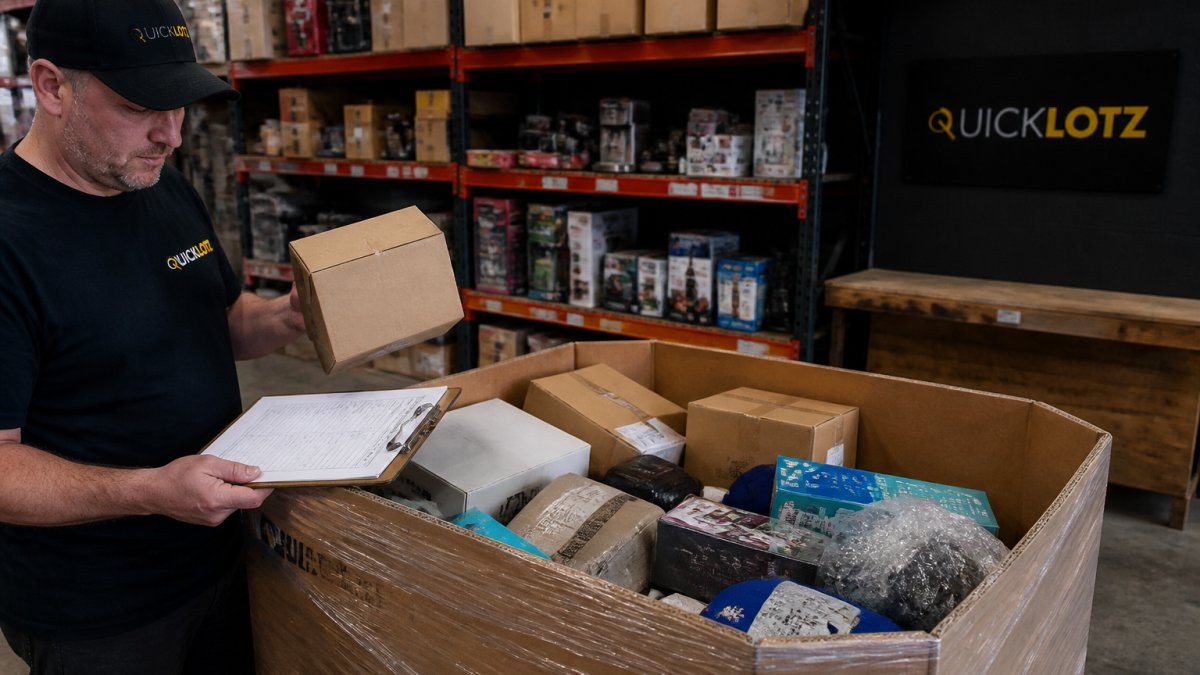
A common mistake is buying returns sight-unseen from an unfamiliar seller with no condition disclosure. Our guide on avoiding damaged goods in liquidation pallets covers the inspection habits that protect your margin.
Manifested Liquidation Pallets vs. Unmanifested Loads for Bin Stores
Manifested liquidation pallets come with an itemized list of contents, while unmanifested loads arrive as a mystery mix. Manifested loads suit planned pricing and category balance; unmanifested loads suit operators who price purely on volume and aren't chasing specific items.
Which is better depends on your pricing model. With flat-price bins, unmanifested loads work well because you're not recovering value per item. With tiered pricing or high-value pulls for online resale, manifested loads give you the visibility to plan.
We'd push back on the idea that one is universally superior. The right split is usually a base of manifested loads for predictable general merchandise plus occasional unmanifested buys for variety. Manifested vs. unmanifested truckloads breaks down the margin math in more detail.
How Online Liquidation Auctions Fit a Weekly Bin Store Restock
Online liquidation auctions fit a weekly bin store restock when you treat them as a scheduled input, not a scramble.
The thing nobody tells you about auctions: consistency beats bargains. Winning one small lot every week builds a predictable pipeline; waiting for a "great deal" leaves empty bins and lost foot traffic.
Quicklotz runs daily online auctions starting at $5, which gives operators a frequent cadence to plan around rather than a sporadic drop.
Vetting a viatrading alternative Before You Commit
Vetting a viatrading alternative comes down to evidence, not sales copy. Ask for manifests, condition grading standards, freight quotes to your zip, and references from stores your size. A supplier that can't answer plainly is telling you something.
Vetting has three layers: supplier verification, buyer protections, and a profitability benchmark run before the load arrives. Do all three and you stop guessing whether a supplier deserves a second order.
Layer 1: Supplier Verification
Before you trust a manifest, verify the business:
- Confirm a physical warehouse address, not just a PO box or contact form.
- Check how long the company has operated and whether it publishes a business registration or terms page.
- Look for a real return and dispute policy, not "all sales final" with no recourse.
A supplier that answers all five plainly is worth a test order. One that dodges two or more is a pass, no matter how good the price looks.
Layer 2: Buyer Protections and Manifest Integrity
This is where small bin stores lose the most money. Confirm these in writing before you bid:
- Manifest type, full manifest (every unit listed), partial manifest (sampled), or no manifest. Know which you're buying.
- Condition grading, how the supplier defines new, like-new, tested, and salvage, and whether grading is per item or per load.
- Dispute window, how many days you have to report a shorted or damaged load, and what evidence they require (photos, count sheets, unboxing video).
Layer 3: The Pre-Purchase Profitability Benchmark
Before you commit, run a simple benchmark on the load. You don't need perfect data, just a realistic range:
- Estimated usable-item rate, for customer returns, plan on a usable rate well below 100%; for shelf pulls and overstock, expect a higher rate. Ask the supplier for their stated rate and discount it.
- Average resale value per usable unit, based on your bin price point and how many units a customer typically buys.
- Sell-through window, how many weeks until the load clears at your traffic level.
- Margin after landed cost, landed cost per unit versus average revenue per unit sold.
If margin after landed cost doesn't clear your target once you apply a conservative usable rate, the load is a pass, even if the manifest looks exciting. Avoiding damaged goods in liquidation pallets covers the inspection habits that protect this benchmark.
Red Flags That End the Conversation
Two red flags should end a supplier conversation immediately: vague answers on condition grading, and freight costs that only appear after you've committed. A third, subtler flag is a supplier who can't state their restock cadence, if they don't know when inventory posts, you can't plan around them.
Use the checklist below as a final gate before your first order:
- Can they show a full manifest sample for the category you want?
- What is the minimum order, and does it vary by category?
- Will they quote freight to your actual address before you bid?
A supplier that clears all eight is a candidate for a test order. A supplier that clears all eight and quotes freight up front is a candidate for a core restock channel.
Start Sourcing with Quicklotz
The challenge for most small bin stores isn't finding inventory. It's finding a supplier that fits the store's size, cadence, and margin math without hidden costs. That's the gap Quicklotz was built to close.
At Quicklotz, we bring over 15 years of reverse logistics experience to sourcing, with daily online auctions starting at $5, worldwide shipping, and strategically located liquidation warehouses. When you're ready to move from comparing suppliers to stocking your bins, you can explore our bin store product range or take a look at a concrete AMZ Premium BIN Store Pallet to see the kind of general merchandise mix we build.
Get started with Quicklotz and turn your sourcing into a reliable weekly pipeline instead of a monthly gamble.
Frequently Asked Questions
What are the best alternatives to Via Trading for small bin stores?
The best viatrading alternative for a small bin store depends on your order size and budget. Look for suppliers that sell case lots and partial pallets, not just full truckloads, and that publish clear manifest details. Online auction platforms let you bid on individual lots, while liquidation companies with regular weekly auctions give you a repeatable restock schedule. Compare minimum order thresholds, freight terms, and how much product detail each supplier shares before you commit.
How much inventory should a small bin store buy to get started?
Start with enough stock to fill your bins once and leave a small buffer, rather than committing to a full truckload. Many new bin store owners begin with a few pallets or case lots and track sell-through for the first month. That gives you real data on which merchandise categories move fastest in your location. Scale your order size only after you know your weekly turnover and how much space you have for backstock.
Are manifested pallets better than mystery pallets for bin stores?
Manifested liquidation pallets usually suit bin stores better because you can see the product mix, categories, and retail values before buying. That helps you plan bin pricing and avoid loads full of items that will not sell in your area. Unmanifested pallets can cost less per unit, but the uncertainty is higher and the damaged-goods ratio is harder to predict. For a store that needs consistent margins, a full manifest reduces guesswork.
Can small bin stores buy liquidation inventory through online auctions?
Yes. Online liquidation auctions are one of the most accessible routes for small bin stores because you can bid on individual lots instead of committing to a full pallet or truckload. Look for auctions that run on a regular schedule, publish lot photos and condition notes, and offer shipping or a nearby pickup point. Check the buyer's premium and freight cost before bidding so your total landed cost still leaves room for profit.