 blog
Why High-Volume Buyers Choose a Different 888lots Alternative in 2026
Last Updated: November 21, 2026
Quick Summary
The right 888lots alternative for high-volume buyers is one that keeps total landed cost low and supply predictable at the order size you actually run. Model acquisition cost, freight, fees, damage and sorting labor before you bid, then start with a small test order and scale into pallets and truckloads once the numbers hold.
- Quicklotz runs daily online auctions starting at just $5 and ships worldwide.
- Quicklotz has served more than 500,000 customers across 127 countries.
- Model landed cost at your real order size, since full truckload freight costs less per unit than LTL pallets.
- Ask suppliers how often they add inventory and treat a vague answer on cadence as a warning.
- Start with small liquidation boxes, move to a pallet, then step into truckloads when storage and labor allow.
Table of Contents
- What High-Volume Buyers Actually Need From an 888lots alternative
- Quicklotz at a Glance: Volume, Auctions and Shipping Reach
- Total Landed Cost: Where High-Volume Buyers Win or Lose
- How to Evaluate Liquidation Inventory Before You Commit
- Liquidation Wholesale Pallets vs Smaller Lots: Matching Supply to Your Resale Channel
- Wholesale Lots for Resellers: Repeat-Order Consistency and Supplier Capacity
- Best Liquidation Sites Compared for Truckload and Pallet Volume
- Start With a Test Order Through Quicklotz
- Frequently Asked Questions
What High-Volume Buyers Actually Need From an 888lots alternative
High-volume buyers need an 888lots alternative that protects margin at the truckload level, not just at the pallet level. That means transparent landed cost, manifests you can verify before bidding, and a supplier with enough repeat capacity to keep your shelves stocked week after week.
At Quicklotz, we have spent more than 15 years in reverse logistics, and we know how easily buyers can chase the lowest sticker price straight into a load full of unsellable returns. The sticker price is not the problem. The problem is everything the sticker price hides.
Below, we break down what actually separates one liquidation source from another, using the same criteria we would apply to our own operation.
Quicklotz at a Glance: Volume, Auctions and Shipping Reach
Quicklotz runs daily online auctions starting at just $5. We ship worldwide and have served more than 500,000 customers across 127 countries.
Our model rests on three things: volume, cadence and reach. We operate strategically located warehouses, which is why we can offer worldwide shipping.
If you want to see the auction format in practice, you can browse live lot auctions before you commit a bid.
Daily auctions give discount bin stores, auction houses and eBay sellers a regular source of new lots to evaluate.
Total Landed Cost: Where High-Volume Buyers Win or Lose
Total landed cost is the acquisition price plus freight, handling, inbound damage, buyer fees, and the labor to sort what arrives. Buyers who only compare unit price are comparing the smallest number in the equation.
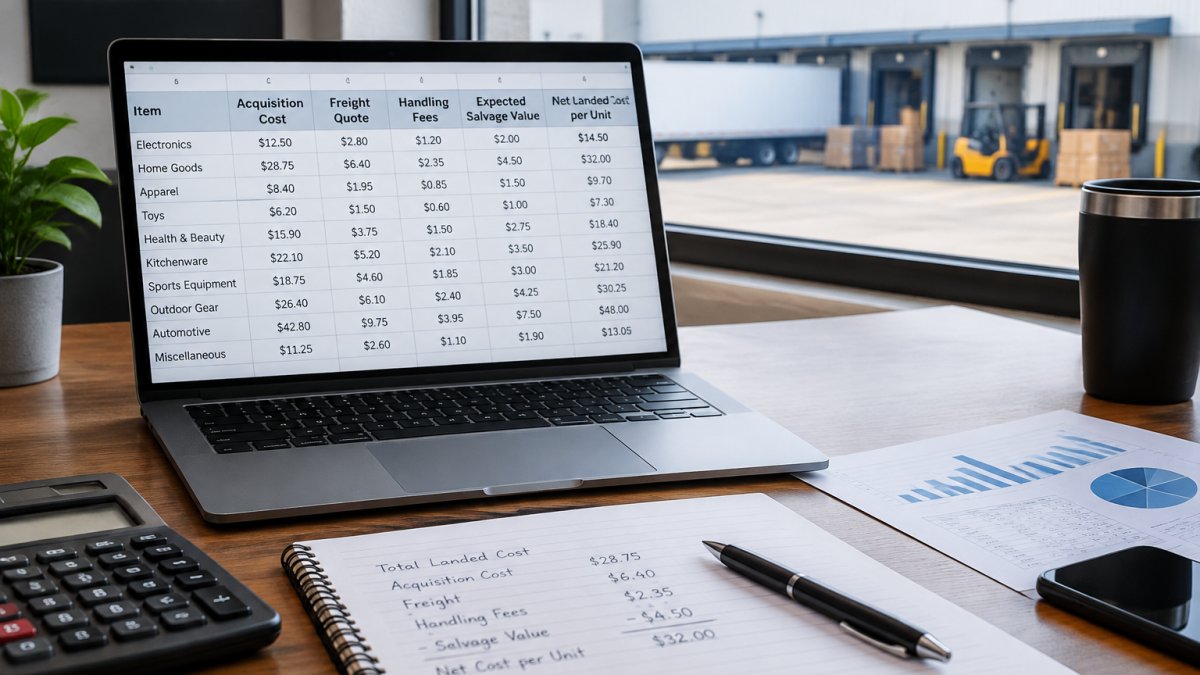
A common mistake is treating freight as a fixed cost you absorb. In practice, freight scales with distance, pallet count and how the load is stacked. Two suppliers quoting the same per-unit price can produce different totals once the truck reaches your door.
Here is the cost structure we recommend modeling for any liquidation supplier:
- Acquisition cost, the winning bid or listed price per lot, pallet, or truckload
- Freight, linehaul, fuel surcharge, liftgate, and residential or limited-access delivery if applicable
- Handling and dock fees, per-pallet in/out charges, appointment scheduling fees, and detention if unloading runs long
- Buyer premium or platform fee, some auction formats add a percentage on top of the hammer price
- Inbound damage and shrinkage, the portion of the load that arrives unsellable or short
- Sorting labor, hours per pallet to inspect, grade, and list, multiplied by your labor rate
- Salvage recovery, what you can recoup from the unsellable portion through local resale, scrap, or donation
The last two lines are where most spreadsheets break, because they require an honest estimate of salvage and returns rather than a hopeful one. A load that looks 20% cheaper per unit can lose that advantage entirely if it requires twice the sorting labor or carries a higher damage rate.
Order size changes the math. A single pallet shipped via LTL freight typically carries a higher per-unit freight cost than a full truckload. That is why high-volume buyers should model landed cost at the order size they actually plan to run, not at the pallet level.
We would rather you model this before you bid. Start with the acquisition cost, add the freight quote, then subtract the expected resale value of the unsellable portion.
For a deeper breakdown of budgeting for inbound freight, see this guide to freight and shipping costs for liquidation truckloads.
How to Evaluate Liquidation Inventory Before You Commit
Evaluating liquidation inventory means reading the manifest, matching SKU counts to stated condition, and confirming what the seller will do when the load does not match. A manifest is a claim, not a guarantee.
A checklist for vetting any load:
- Request the manifest and confirm item-level detail, not just category totals
- Ask what percentage of the load is customer returns versus overstock
- Confirm the stated condition: new, like new, shelf pull or salvage
- Ask how the seller handles manifest discrepancies after delivery
- Check whether you can inspect goods in person or through a warehouse visit
That first box matters more than any other. If a supplier will not let you visit and see the goods, they may be hiding something.
For a step-by-step method, read how to verify liquidation pallet manifests before you bid.
Liquidation Wholesale Pallets vs Smaller Lots: Matching Supply to Your Resale Channel
Liquidation wholesale pallets suit buyers who can move volume fast and absorb mixed condition. Smaller lots suit sellers testing a category or running a lean operation.
The right format depends on your resale channel, not on which option looks cheaper per unit:
- Online arbitrage and single-listing sellers need smaller lots with tighter category focus
- Bin stores and discount retailers need steady pallet volume with predictable category mix
- Auction houses need bulk lots they can break into individual sales
- Truckload buyers need loads they can receive and the logistics to handle them
If you are ready to buy at the truckload level, you can shop truckload liquidations and review current inventory.
Watch out: buying a truckload before you have the storage and labor to process it turns a good price into dead capital. Match the format to your floor space first.
Wholesale Lots for Resellers: Repeat-Order Consistency and Supplier Capacity
Wholesale lots for resellers are only useful if the next order looks like the last one. Consistency beats a one-time bargain every time.
A supplier can have great inventory today and nothing you want next month. High-volume buyers need cadence: a predictable flow of new lots in categories that actually sell for them. Ask any supplier how often they add inventory, and treat a vague answer as a warning.
At Quicklotz, we started by buying a single pallet to resell on eBay, then opened a small store, then a second one. Wholesale became bigger than retail when we let customers make the money. Moving inventory is different from squeezing every dollar out of it, and growth comes from cashflow and cadence rather than one perfect margin.
That is also why we listen to what buyers ask for.
Best Liquidation Sites Compared for Truckload and Pallet Volume
The best liquidation site for a high-volume buyer is the one that keeps landed cost low and supply predictable at the order size you actually run. This section evaluates sourcing formats the way a high-volume buyer should: by total landed cost, repeat-order consistency, manifest accuracy, and logistics fit.
Here is how the main sourcing formats compare on the criteria that decide a recurring bulk purchase:
| Sourcing Format | Typical Volume | Manifest Detail | Repeat-Order Consistency | Best For | Main Trade-off |
|---|---|---|---|---|---|
| Daily online auctions | Lot to pallet | Varies by lot | High cadence, variable mix | Testing categories fast | Competition can lift final price |
| Manifested pallets | Pallet | Item-level | Moderate | Bin stores, resellers | Condition still mixed |
| Truckload liquidation | Full truckload | Item-level | Depends on supplier allocation | Auction houses, retailers | Needs storage and labor |
| Unmanifested loads | Pallet to truckload | Category only | Low predictability | Experienced salvage buyers | Higher risk, wider margin swing |
| Small liquidation boxes | Box | Limited | High cadence, low volume | New resellers | Low volume per order |
A table alone will not tell you which supplier to use. The criteria behind it will. Evaluate every 888lots alternative on these five dimensions before you place a repeat order:
- Supplier capacity and replenishment frequency, Ask how often new lots are added and whether the supplier can allocate consistent volume to your account. Treat a vague answer on cadence as a warning.
- Manifest accuracy and condition grading, Request item-level manifests, not category totals, and compare stated condition against what actually arrives on a test order. Track the discrepancy rate across two or three orders before scaling.
- Truckload logistics, Confirm freight arrangements, dock requirements, delivery windows, unloading responsibility, and the claims process for shortages or damage.
- Risk and recovery policies, Compare how each supplier handles manifest discrepancies, missing items, returns, and disputes. A clear written policy is worth more than a slightly lower price.
Match the format to your operation rather than to the lowest unit price:
- Online arbitrage and single-listing sellers need smaller lots with tighter category focus and high cadence.
- Bin stores and discount retailers need steady pallet volume with predictable category mix and reliable replenishment.
- Auction houses need bulk lots they can break into individual sales, with manifests detailed enough to grade before the sale.
- Truckload buyers need manifested loads, dock-ready logistics, and a supplier with enough repeat capacity to fill a recurring schedule.
Watch out: a supplier that cannot tell you its replenishment cadence or its claims process in writing is not ready for high-volume purchasing, no matter how good the current inventory looks.
If you are ready to buy at the truckload level, you can shop truckload liquidations and review current inventory, then ask about allocation and freight terms before you commit to a recurring order.
Start With a Test Order Through Quicklotz
Start with a small order, measure the actual margin, then scale into pallets and truckloads once the numbers hold. That sequence protects your cash while you learn a supplier's real accuracy.
You can order small liquidation boxes as a low-risk test. They ship fast, so you get a real read on condition and category mix without committing to a full load.
From there, the path is straightforward: test a box, move to a pallet, then step into truckloads when your storage and labor can handle the volume.
High-volume sourcing rewards buyers who check the numbers before they commit, and it punishes anyone who trusts a manifest on faith. Quicklotz gives you daily auctions starting at $5, worldwide shipping, and more than 15 years of reverse logistics experience behind every load, so you can test small and scale with confidence. Get started with Quicklotz and build a supply chain you can actually plan around.
Frequently Asked Questions
Which liquidation suppliers are best for high-volume buyers?
High-volume buyers should weigh manifest accuracy, lot size flexibility, freight terms and whether the supplier can fill repeat orders on a predictable schedule. A supplier that only runs sporadic auctions forces you to scramble for stock. Quicklotz runs daily online auctions starting at $5, ships worldwide and has 15+ years of reverse logistics experience, which makes volume planning easier than one-off sourcing. Compare landed cost per unit, not headline price, before committing to any supplier.
What should bulk buyers compare when choosing an 888lots alternative?
Compare four things: total landed cost including freight and buyer fees, manifest accuracy and inspection terms, minimum order and lot flexibility, and how reliably the supplier restocks. Ask whether you can visit the warehouse and see goods before buying. A supplier that will not let you inspect is a warning sign.
Is it better to buy liquidation wholesale pallets or smaller wholesale lots?
It depends on your resale channel. Bin stores and auction houses usually need liquidation wholesale pallets or truckloads to keep shelves full, while eBay and Amazon sellers often start with smaller lots to test categories before scaling. Smaller lots lower your risk per order; pallets lower your cost per unit. Many buyers run both, using small lots to test and pallets to restock proven categories.
How do I estimate profit on a liquidation pallet before buying?
Start with acquisition cost plus freight and any buyer fees to get landed cost. Estimate resale value from recent sold listings in your channel, then subtract platform fees and a damage allowance. Manifested lots give you item-level detail to work from; unmanifested lots need a larger damage buffer. At Quicklotz, we know from our own reselling background that moving inventory matters more than squeezing every dollar from one pallet, so price your margin around turnover speed.