 blog
Direct Liquidation vs Via Trading for Small Business Buyers
Last Updated: November 7, 2026
Quick Summary
Direct Liquidation runs online auctions while Via Trading runs a fixed-price catalog, so the choice depends on whether you want bidding upside or cost certainty on liquidation pallets. Compare landed cost per resellable unit, not sticker price, since buyer premiums and freight can flip which platform is cheaper.
- A 15% buyer premium on a $1,000 pallet adds $150 before freight and handling.
- Keep any single lot's all-in landed cost under one month of your inventory budget.
- Photograph the unopened pallet and film the unboxing to support any claim.
- Part-time eBay flippers should start with small fixed-price lots for repeatable cost.
- In a survey of 307 owners, 63% had less than three months of cash on hand.
Table of Contents
- How the Two Platforms Compare for Small Business Buyers
- Direct Liquidation vs Via Trading Cost: Fees, Premiums, and Landed Cost
- Manifested Liquidation Pallets: What the Paperwork Tells You
- Liquidation Pallets No License Required: What Small Sellers Need to Know
- B2B Liquidation Marketplaces: Where Quicklotz Fits for Small Resellers
- Which Platform Fits Your Resale Model and Budget
- Start Sourcing with Quicklotz Daily Auctions
- Frequently Asked Questions
How the Two Platforms Compare for Small Business Buyers
Choosing between directliquidation vs viatrading for small business comes down to one structural difference: Direct Liquidation runs online auctions, while Via Trading runs a fixed-price catalog. That single distinction shapes everything else, from how you budget to how much risk you carry on each lot. The buyers who succeed are the ones who match the buying model to their cash flow and storage, not the ones chasing the lowest sticker price.
Auction vs Fixed-Price Buying Models
Direct Liquidation presents its marketplace as an online auction channel for manifested wholesale lots, including pallets and truckloads (Direct Liquidation platform description). You bid, you wait, and you may lose. Via Trading describes a buying process built around browsing inventory, reviewing manifests, ordering, payment, shipping, and pickup (Via Trading buyer instructions). Fixed price means certainty. Auctions mean upside and wasted afternoons.
For a beginner, that matters more than the discount. Auctions reward buyers who can walk away. New resellers rarely can.
Inventory Volume and Lot Sizes
Both platforms sell pallets and truckloads, so lot size is not the real divider. Turnover is. Via Trading reports serving more than 60,000 buyers and selling over $1 billion in merchandise (Via Trading, "Why Buy Liquidation from Via Trading"), and it states plainly that liquidation inventory changes quickly and conditions vary between opportunities. Direct Liquidation gives you sales history per pallet through its pricing tool, which helps you judge what similar lots fetched. Neither platform guarantees what your specific lot contains.
Direct Liquidation vs Via Trading Cost: Fees, Premiums, and Landed Cost
The Direct Liquidation vs Via Trading cost comparison cannot be settled with a headline price, because the number that matters is landed cost per resellable unit, not the lot price on the listing. The sticker price is rarely the full cost a small buyer pays once fees, freight, tax, and labor are counted. Build the full number before you commit.
The five cost layers small buyers miss
- Lot price or winning bid. On Direct Liquidation this is the hammer price; on Via Trading it is the listed catalog price. Neither is your cost.
- Buyer premium or platform fee. Auction channels may add a buyer's premium on top of the winning bid, and the rate can vary by sale. Confirm the total checkout price on any platform before paying. Watch out: a premium on a $1,200 pallet adds cost you did not budget for.
- Freight or pickup. A single pallet shipped residential often carries liftgate and residential-delivery surcharges on top of linehaul. Local pickup at a warehouse dock avoids most of that but requires a vehicle, a dock, or a forklift arrangement.
- Sales tax and handling. A resale certificate removes sales tax on inventory in most states, but handling, palletizing, and re-delivery fees do not disappear.
- Labor and testing. Sorting, testing, cleaning, and listing a returns pallet is real hours. A common pattern is 8-20 labor hours per pallet for a part-time reseller, which is the cost most often left out of the math.
A realistic small-order landed-cost walkthrough
Take a manifested general-merchandise pallet listed at $1,000 with a stated 250 units. Add a 15% buyer premium ($150), a residential freight quote of $220 including liftgate, and $60 in handling and supplies. Landed cost is $1,430, or $5.72 per unit across all 250.
Run the same math on a Via Trading fixed-price lot and the structure is identical; only the fee line changes. The lesson is not that one platform is cheaper. When freight or an itemized manifest leaves a gap between what a lot promises and what arrives, trading missing items between resellers can help make the comparison reflect usable inventory rather than sticker price alone.
Small-lot shipping economics
Freight is where small buyers often get hurt. Shipping costs can vary widely with distance, and liftgate, inside delivery, and appointment fees can stack on top. Before bidding or ordering, get a quote to your actual zip code and compare it against pickup. The liquidation marketplace buyer protection policies you rely on also affect true cost, because weak recourse turns a bad lot into a total loss rather than a partial one.
Cash-flow reality check
In a survey of 307 small-business owners, 63% had less than three months of cash on hand (Revenued Q1 2026 Small Business Economic Outlook Report). Tie up working capital in a slow-moving truckload and you feel it fast. A practical rule for a first purchase is to keep the all-in landed cost of any single lot under one month of your available inventory budget, so one bad manifest does not stall your whole operation.
Manifested Liquidation Pallets: What the Paperwork Tells You
A manifested liquidation pallet is a lot sold with an inventory list describing its contents, typically by category, quantity, and condition. The manifest is a description, not a warranty. Retailers generate these lists from returns, overstock, and shelf pulls, and the condition column is where profits live or die. What separates a good small-business buy from a bad one is not the manifest itself but how accurately it predicts sell-through, and what recourse you have when it does not.
Reading a manifest for margin, not just contents
Read manifests for four things: category mix, stated condition, whether the list is itemized or summarized, and whether quantities are exact or approximate. A summarized manifest on customer returns tells you almost nothing about sell-through rate. An itemized manifest with per-unit condition grades lets you estimate resale value line by line. Testing quality before buying electronics at scale is a sensible precaution for any manifested lot where the condition grade is vague.
Risk-adjusted profitability by condition grade
Expected margin generally falls as manifest accuracy drops. A useful way to model it for a small order:
- New / overstock, itemized: generally more predictable resale and lower labor per unit. Often suited to part-time sellers who need repeatable margins.
- Customer returns, tested and graded: some missing accessories and moderate testing labor. Often suited to experienced resellers who can absorb variance.
- Customer returns, untested or summarized: higher damage and missing-item risk and more labor per resellable unit. Only workable if the price per unit is low enough to absorb a poor outcome.
- Salvage / shelf pulls: typically lower sell-through and higher handling cost.
The practical takeaway: do not compare a tested, itemized pallet against an untested, summarized pallet on sticker price alone. The untested lot has to be meaningfully cheaper per unit to justify the added risk and labor.
Platform policies and buyer recourse
This is where Direct Liquidation and Via Trading differ in ways that affect your downside. Auction platforms and fixed-price catalogs both publish buyer terms, but the specifics, dispute windows, cancellation rules, claims processes, and remedies when a shipment differs from its listing, vary and can change.
Photographing the unopened pallet, filming the unboxing, and logging missing or damaged units against the manifest creates a record that supports any claim you file. If you are new to the terminology, a plain guide to how liquidation works will save you from misreading a manifest before you bid, and it will help you spot the difference between a condition grade and a marketing description.
Liquidation Pallets No License Required: What Small Sellers Need to Know
Licensing requirements for buying liquidation pallets depend on your location and resale setup, so confirm them with your local authorities. You are buying inventory, not operating a regulated trade. A resale certificate may be needed in your state to avoid paying sales tax on inventory you intend to resell, and your local business registration may have its own requirements.
The bigger constraint is capital, not paperwork. Minimum orders vary by platform and lot, and a part-time eBay seller may be able to start with a single pallet if the numbers work. If you want the full walkthrough, this guide to starting a wholesale liquidation business covers registration, sourcing, and resale channels step by step. Skip the truckload until one pallet turns a profit twice.
B2B Liquidation Marketplaces: Where Quicklotz Fits for Small Resellers
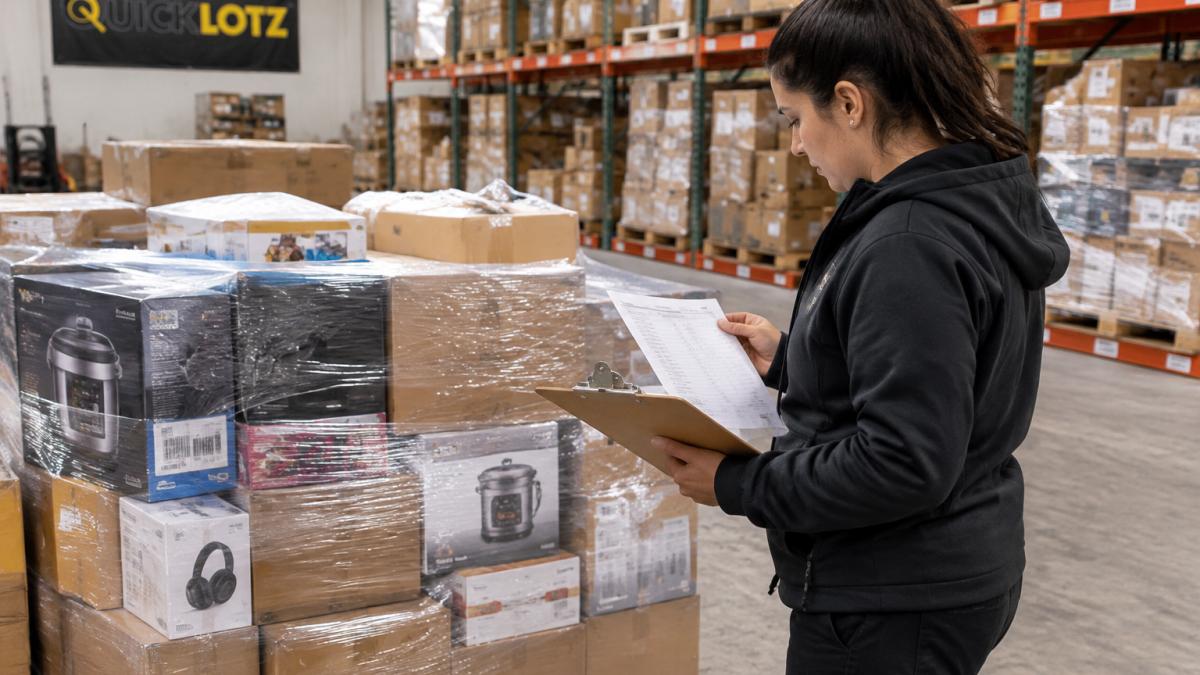
B2B liquidation marketplaces split into two camps: auction-driven platforms and fixed-price suppliers. We run daily online auctions starting at $5, ship worldwide, and have spent over 15 years in reverse logistics sourcing distressed and overstock merchandise at 60-90% off retail. For bin store operators who need consistent volume, that auction cadence matters more than a one-off bargain.
Here is the honest trade-off. Auctions still require you to show up and bid, and condition varies lot to lot on every platform in this industry. What we control is supply frequency and category access, not what a retailer happened to return last month.
| Platform | Buying Model | Best For | Watch Out For |
|---|---|---|---|
| Direct Liquidation | Online auctions | Buyers who can bid patiently | Auction losses, variable fees |
| Via Trading | Fixed-price catalog | Buyers who want certainty | Fast-moving inventory |
| Quicklotz | Daily auctions from $5 | Bin stores, repeat volume | Condition varies by lot |
Which Platform Fits Your Resale Model and Budget
Match the platform to the business, not the other way around.
- Part-time eBay flipper: start with small fixed-price lots. Predictable cost beats a bargain you cannot repeat.
- Amazon reseller at scale: test electronics quality before volume buying, on any platform.
- Bin store operator: prioritize auction frequency and category depth over single-lot price.
- Auction house buyer: manifested pallets with itemized lists give you resale-ready inventory.
Whichever you pick, run the landed-cost math first and keep three months of cash free. That single habit separates resellers who scale from resellers who quit.
Start Sourcing with Quicklotz Daily Auctions
The challenge is not finding liquidation inventory. It is building a supply line you can count on every week without wrecking your cash flow. Quicklotz runs daily online auctions starting at $5, ships worldwide, and has over 15 years of reverse logistics experience. Browse the full product catalog to see current categories, or read whether Via Trading is the right supplier for small bin stores if you are still weighing platforms. Get started with Quicklotz and turn a reliable auction schedule into steady inventory.
Frequently Asked Questions
Is it profitable for a small business to buy liquidation pallets?
It can be, but profit depends on landed cost, product condition, and sell-through rate. Quicklotz lets buyers purchase merchandise at 60-90% off, which leaves room for margin if you account for freight, buyer fees, and unsellable items. Before committing, calculate your total cost per unit including shipping and expected returns, then compare it against recent sold prices on your resale channel. Start with a single pallet to test demand before scaling.
Do you need a business license to buy liquidation pallets?
Most B2B liquidation marketplaces sell to registered businesses, and some ask for a resale certificate or business license during registration. Policies vary by platform and by state, so confirm the requirements before you bid. Quicklotz works with online resellers, discount stores, and auction houses; contact the team to confirm what documentation your account needs. Buying without a license may limit access to certain lots or affect tax treatment on resale.
Are liquidation pallets from Direct Liquidation or Via Trading manifested?
Both platforms describe manifested wholesale lots, meaning you can review an inventory list before buying. Manifests are a guide, not a guarantee: conditions vary, and the research notes that quality testing is recommended for electronics bought at scale. Always read the condition notes and return policy before bidding.
Which liquidation marketplace is better for a beginner reseller?
Beginners benefit from lower minimum orders, clear manifests, and predictable fees. Quicklotz runs daily online auctions starting at just $5 and ships worldwide, which suits part-time eBay sellers testing small lots. Compare total landed cost, not just the bid price, and start with one pallet to learn the condition mix before scaling.